Sunday, November 25, 2018

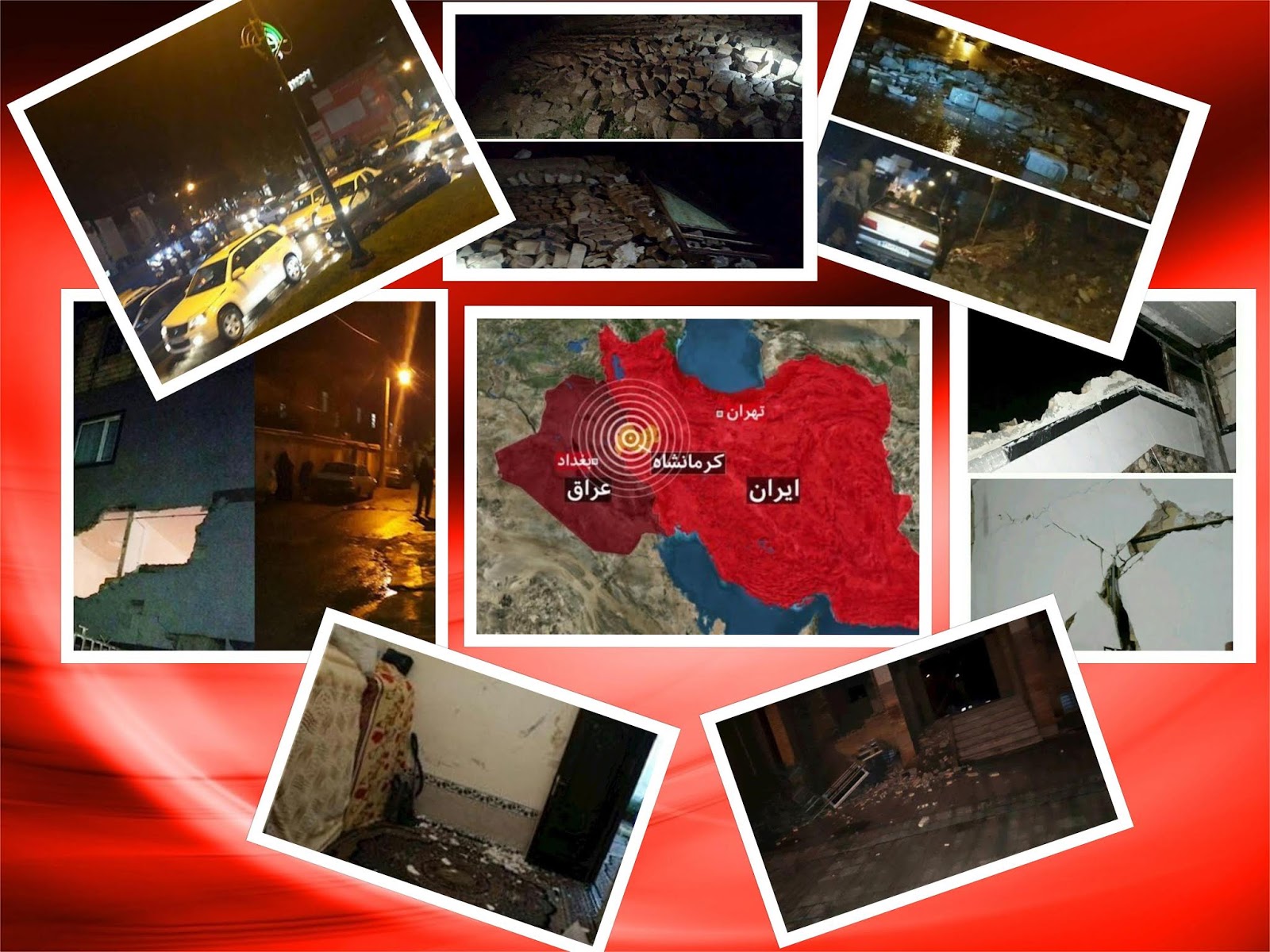
An earthquake of 6.3 magnitude shook many cities in Iran in the provinces Kermanshah, Ilam, Lorestan. The earthquake was felt in Tabriz, Orumieh and in Baghdad(Iraq) west of Iran such. Based on the recent report 136 people were injured. There's no report of any loss of life as of yet.


******
On their 21st day of strikes, the workers of Haft Tapeh sugarcane mill gathered on Sun. Nov 25 again in front of the mayor’s office in Shush, in Iranian province of Khuzestan, to protests against unpaid wages, the imprisonment of their colleagues and the mismanagement of the factory by private owners.
Haft Tapeh is Iran’s largest sugarcane factory. The workers began their protests earlier this month, demanding the payment of their due of several months. They are also demanding the removal of private owners of the company who have pushed the factory towards bankruptcy. In response, the Iranian regime dispatched security forces and arrested several of the protesters.
On Sunday, the workers of Haft Tapeh were chanting, “Jailed workers must be freed.” The workers also voiced their support and solidarity with the workers of Ahvaz Steel factory, who are holding similar protests over their unpaid wages.
The workers also called out the names of the private owners and called for their ouster. It’s said that the relatives of Hassan Rouhani’s deputy president Jahangiri have been managing the factory. The support for the factory workers has grown and the steel factory of Ahvaz, people of Shoosh, the university students, mine workers in Isfahan and a number of political prisoners have expressed support for the workers of Haft Tapeh which is the frightening factor for the Iranian regime.  

******

Shahrzad Nazifi, a motocross champion, was arrested on Sunday, November 18, by security forces in Tehran and taken to Evin Prison because of her Baha’I faith.The security agents went to Ms. Nazifi’s house and after about 5 hours of inspections, they seized some of her personal belongings, including books, cell phone, and laptop.
In another report on Tuesday, November 20, Bahai’s citizens Sepideh Keshavarz, Mahvash Edalati (Za’eri), Shabnam Essakhani, Anousheh Rayeneh were either arrested or sentenced.
Baha'i women, Monica Alizadeh (Aghdassi) in Tabriz, and Nasrin Khajeh and Mojgan Khoshhal in Isfahan, and May Kholousi and her daughter, Saghi Fadaii, were arrested in October.
Baha’i women and citizens are systematically deprived of their human rights by the Iranian regime while according to article 18 of the Universal Declaration of Human Rights and article 18 of the International Covenant on Civil and Political Rights, “everyone shall have the right to freedom of thought, conscience and religion. This right shall include freedom to have or to adopt a religion or belief of his choice, and freedom, either individually or in community with others and in public or private, to manifest his religion or belief in worship, observance, practice and teaching.”

******
Between Nov 4 and 14 of 2018, Seven Iranian women committed suicide in Tehran, and in cities of Fereydoon Kenar, Urmia, Sardasht, Oshnavieh and Likak in northern and western Iran, due to poverty and economic problems. From March to the end of October, 80 suicides of Iranian girls and women have been registered.

According to the annual statistics released by the Journal of Forensic and Legal Medicine in September 2018, in Iran, women's suicide rates in 2017 alone were more than 1,365 people, at least 4 women per day. According to the World Health Organization, the suicide rate of Iran in 2014 was 5,3 in every 100,000 people. Iranian women are more vulnerable to suicide than other groups in the society. In 2007, Iran ranked the third country in which women were outnumbering men in committing suicide. According to a study published in 2008, women's suicide rate in Iran was double that of men.

Sunday, November 18, 2018


The strikes and sit-ins of teachers as well as protests by other social sectors continued in recent days across Iran. Following the call issued by the Teachers’ Coordination Council, Iranian teachers held strikes and sit-ins on Tuesday, November 13, and continued on Wednesday, November 14. The strikes and sit-ins were held despite various forms of threats and harassment by the regime’s repressive organs and forces and the summoning and arrests of a number of teacher activists. The second day of the second round of strikes and sit-ins of teachers took place in more than 40 cities including Tehran, Isfahan, Shiraz, Tabriz, Ahvaz, Mashhad, Yazd, Kermanshah, Ilam, Hamedan, Ardebil, Jolfa, Babol, Sari, Noshahr, Langrood, Karaj, Shahriar, Shahr-e Ray, Saveh, Sanandaj, Baneh, Saqqez, Marivan, Ivan-e Gharb, Sirvan, Chaboksar, Kazerun, Lamerd, Homayounshahr, Jam, Asaluyeh, Bushehr, Qazvin, Zanjan, Shahr-e Kord, and Charmahal-e Bakhtiari.
The strikes of the workers of Sugar cane factory of Haft Tape and Ahwaz Steel factory continued to Sunday as well. Two workers rep Ismaeil Bakhsi and Mosolem Armand were arrested by riot forces and a number of workers were beaten. The strike continues despite these measures.
The strike and sit-in of teachers were held in protest against the arrest and suppression of teachers, their dire living conditions, unbridled inflation and their dwindling purchasing power. They also demanded the elimination of discrimination against employed and retired teachers and educators.
In some cities, students and their parents joined the teachers in solidarity.
In other news, a group of housewives in Mashhad took to the street in protest to water cut off and blocked the road on Tuesday, November 13.
On the same day, professors of Farabi Medical Sciences University in Kermanshah refused to hold classes in protest to the horrific conditions of education. The university’s students also held a protest on campus from 11 a.m. until 6 p.m., demanding freedom of speech and revoking tuition fees for education.
On Monday, November 12, depositors of the Alborz Nahalneshan Development Institute in Karaj held a protest rally outside the Central Bank in Tehran to protest swindling of their money and properties. The presence of women in this gathering was substantial. The State Security Force (SFF) and anti-riot troops attempted to disperse and prevent the gathering of the defrauded depositors, but faced staunch resistance by protesters and failed to make any arrests.
On the same day, the residents of Vanak Village in Tehran held a protest rally against the demolition of their houses. Residents of the Vanak Village gathered at the site of one of the demolished houses in the periphery of Az-Zahra University.
SSF agents, municipality workers, and the traffic police had surrounded the Vanak Village since 5:00 a.m. to demolish the houses confiscated by Az-Zahra University.
The residents of these houses and their supporters gathered under the rain at 7 a.m. outside Az-Zahra University, and held up banners to protest such an inhuman measure.
Also on November 12, employees of the Khomeini Hospital in Karaj held another protest. They have not received their salaries for 12 months.

******
Iranian Married women must have their husbands’ permission, and single women as well as young women under 20 years of age must have their fathers’ permission before they can participate in any hiking or nature tours. 
The official IRNA news agency reported on Tuesday, November 13, that the directive of Hiking Board of Razavi Khorassan Province had issued a statement on November 4, , to hiking clubs. The directive reads in part, “The so-called sports activities which are increasingly spreading under the pretext of nature tours, hiking, etc. in mixed-gender groups and are planned as illegitimate sources of income promote moral promiscuity, unveiling of women, spread of shamelessness and liberalism, and lead to immoral and illicit relations among women and men, targeting the genuine culture and roots of Iran, Islam and the foundations of the family.”
The second paragraph of this directive reads, “To observe article 1105 of the Civil Code as well as the religious decrees of religious scholars, and to protect the foundation and bases of families, it is going to be required that married women have their husband’s permission and single women and young women under 20 must have their father’s permission to participate (in such activities).”
Misogyny is institutionalized in the clerical regime’s laws in Iran. The regime's Civil Code depicts women as men’s captives or sex slaves. Specifically, a nine-year-old girl can be forced into marriage on her father’s order, and she must live anywhere her “husband” wants and cannot leave home, go to work or travel without his permission. Article 1105 of the Iranian regime’s Civil Code stipulates, “The family is headed by the husband and the woman may not leave home without the husband’s permission.”

******
Sharareh Almassi a 27 years old young woman 27was hanged on Tuesday, November 13, in the Central Prison of Sanandaj in Iran after five years of imprisonment. She was arrested and jailed five years a go for allegedly killing her husband, Kaveh Gholam Veissi during a family dispute.
A group of civil and human rights activists and campaigners against the death penalty gathered outside the Central Prison of Sanandaj since 4 A.m. to prevent execution of Sharareh Almassi. Sharareh Almassi is the 85th woman who is executed under Hassan Rouhani, the Iranian regime’s president.
Last month, another young woman, Zeinab Sekaanvand was hanged in the Central Prison of Urmia.
The UN High Commissioner for Human Rights Michelle Bachelet issued a statement on October 5, 2018, condemning the execution of Zeinab Sekaanvand, in which she stressed that the UN Human Rights Office opposes the use of the death penalty in all circumstances, as no judiciary in any part of the world is mistake-free.
The death penalty violates the most fundamental human rights, the right to life and the right to freedom from torture and cruel, inhuman and degrading punishment. The death penalty is also considered discriminatory as it is often used against the most vulnerable in society, including the poor, ethnic and religious minorities, and people with mental disabilities.
Execution is a tool which helps the Iranian regime to hold its grab on power. Over 3,600 people have been executed over the past five years under Hassan Rouhani. In the same period, 85 women have been executed.
Iran is the world’s leading per Capita executioner. It also holds the record in the execution of women and minors. Among the reasons that lead to the execution of women are early forced marriages, being deprived of the right to divorce, domestic violence against women, and poverty.


Sunday, November 11, 2018

NEWS))))))


The Iranian-Canadians gathered in front of the Parliament Hill and across from PM office yesterday on Sat. in a cold and snowy weather in Ottawa as part of their weekly gathering and stood in solidarity with the Iranian Truck drivers on strike. They also called for the freedom of all political prisoners and regime change in Iran.


******
According to Women committee of the NationalCouncil of Resistance of Iran Nov,9, two Iranian women, Azam Dideban and Ameneh Zaher Sari have been arrested and detained by the intelligence and security forces in Mashhad and Ahvaz on November 5 and 6, respectively. Azam Dideban was arrested on November 5, in the protest gathering outside the Ibn-e Sina Hospital of Mashhad, demanding the release of teacher activist Hashem Khastar who was kidnapped and arrested by the State Security Force. The State Security Force had announced that all those arrested in this gathering were released on the same night, but Azam Dideban was not released. She was taken to the detention center of the Intelligence Department.
Ameneh Zaher Sari is a graduate of accounting and resides in the Alavi neighborhood of Ahvaz. Ameneh is the third person in her family to get arrested and detained in recent days. Intelligence agents arrested her father, Hattab, and brother, Amin on Monday, November 5, and took them to an unknown location.
The Iranian regime has arrested and detained a number of women including Hakimeh Ahmadi, a civil rights activist and mother of two, Lamya Hemadi, 20 and seven months pregnant, Zoudiyeh Afrawi, 55, and Ghaisiyeh Afrawi, 60, residents of Albou Afri village in Susangerd, and Baha'i women, Elham Salmanzadeh and Niloufar Hakimi, to name a few.
The teacher activist Hashem Khastar was released on Sat. from the mental ward of Ibne sina hospital in Mashhad. Khastar who was kidnapped by the agents of intelligent ministry, upon his release wrote a message to the teaching community and the Iranian people, thanking them for his release and promised to support the Iranian cause for freedom. He said that he would write about his kidnapping ordeal.


******
The case of 2 Iranian young women who had complained about the attack of State Security Forces against them was rejected. "The 9th Branch of the Prosecutor's Office of the Armed Forces’ Judiciary Organization, has issued a prohibition of prosecution to the case, arguing that there is not sufficient evidence," said Mohammad Hossein Aghasi, a defense attorney for the two young women, in an interview with the official IRNA news agency. A video clip disseminated in the social media on April 18, 2018, showed at least four Guidance Patrols attacking four young women in a park, beating and shoving them around for improper veiling and refusing to get on the Patrol’s van. One of the young women who suffered from a heart condition and went unconscious as a result of the beatings. The video clip went viral and raised public outrage in Iran and around the world.
Sadeq Amoli Larijani, head of the Judiciary, stressed on April 24, 2018, the need for the State Security Force to act within the framework of law and religion. He reiterated, “One must not allow anyone to resist against the SSF’s legal measures or insult its agents. The SSF must not back down whatsoever.” (The state-run ISNA news agency – April 23, 2018)
The state-run Kayhan daily which reflects the views of the regime’s supreme leader, Ali Khamenei, also wrote that the SSF officers must be praised. Mohammad Jafar Montazeri, said in defense of the police, that the video was not clear and it was a set up seeking to distort the image of the law enforcement officers.
Following of the regime’s outrageous handling of this case despite overwhelming domestic and international repugnance, the regime’s court prosecutor did not consider the witnesses to be sufficient and rejected the appeal by victims of the SSF violence.


******
Iran’s Azad University officials have banned students living in girls’ dormitories from wearing comfortable clothing. According to Azad University officials, if a person does not meet the criteria for this instruction, the "Individual Adornment Committee" can prevent them from entering the university.
The Individual Adornment Committee is one of the new organs set up to crack down on female students and impose the compulsory veiling on female students of Azad University in Iran.
According to the university's instructions, the covering of female students should be the chador with suitable manteaux, trousers, scarves and socks in decent colors, or long sleeves and under the knee manteaux with conventional trousers and stockings.
Also, the hair and body of the woman should be covered according to the religious hijab. Women's makeup is also forbidden.
The new bans by the Azad University have been announced to various units of the university since September 29, entitled, "Authorized and unauthorized examples of covering and appearance of the Azad University."
The instructions also prohibit short sleeves for men.(The state-run Fars news agency - November 3, 2018)
The research center of the Iranian regime’s parliament (Majlis), published a report in July 2018, according to which nearly 70 percent of Iranian women either do not believe in the Sharia veil (Chador) or are among “the improperly veiled” and protest the compulsory veil in Iran.
The report confirms that Iranian women observe the veil only through coercion and harsh restrictions. The report says there actually is a distaste regarding the (Chador) in part of society which leads them to choose the Customary Veil over the (Chador).
Chador is a head-to-toe, usually black, veil that covers all the body except for the face.
The term, Customary Veil, used in this report is meant to refer to the scarf or shawl that Iranian women use to cover their hair only to comply with the regime’s compulsory dress code and not out of their own religious convictions. The regime has made up the term, “improperly veiled” or “Bad-Hijab” in Farsi, to refer to this group of women.


Sunday, November 04, 2018

NEWS))))))


According to the Secretariat of the National Council of Resistance of Iran Nov. 1, from Thursday morning, the fourth round of strike of heavy truck drivers began in Iran, and covered vast sections of the country. Drivers from different provinces including Tehran, Isfahan, Khuzestan, West Azarbaijan, East Azarbaijan, Khorasan Razavi, South Khorasan, North Khorasan, Sistan and Baluchestan, Fars, Kermanshah, Kerman, Hamedan, Golestan, Zanjan, Semnan, Hormozgan and others stopped working. Drivers had earlier gone to strike in June, August and October 2018 to protest their dire livelihood conditions, low freight rates, expensive spare parts, tough insurance conditions, and so on. Their third round of strike lasted 21 days. Strikers, in addition to their previous demands, called for the release of drivers who were arrested in the third round of the Nation wide strike. Mrs Maryam Rajavi, the president elect of the Iranian resistance called on all youth to give strikers financial and moral support and called on labor unions and the International Labor Organization and other organizations defending the rights of workers and the working people to condemn the repressive measures taken by the Iranian regime against drivers and to support their strike to get their rights.


 ******
On Monday, October 29, Iranians fought the Iranian Regime every step of the way in order to celebrate Cyrus day. Cyrus is the ancient Persian emperor credited with forming the identity of Iran. Many Iranians wanted to travel to Cyrus’s tomb at Pasargadae in Fars Province to pay tribute to this great man, but the Iranian Regime tried everything to prevent the Iranian public from going there out of fear. The Iranian regime’s security sectors sent out threatening texts to public not to observe Cyrus day. IRGC also announced that military drills would be near the tomb and warned hospitals to expect increased casualties. Despite all these suppressing measures many Iranians got to Cyrus’ tomb and others held protest gatherings in their own cities, with Tehran being a prominent example.
King Cyrus II was an ancient Iranian leader, responsible for creating the largest empire of civilized nations known in the world in 600 BCE and the world’s first human rights charter. His life is celebrated on October 29, as that is believed to be the day that he conquered Babylon and freed the Jewish people from slavery, before declaring that the temple in Jerusalem be rebuilt, and giving the Jewish people the choice of returning to their homeland or joining him. He is also considered a just ruler in Islamic holy readings, but the Iranian Regime does not recognize the day, as they wish to do away with all pre-Islamic Iranian celebrations.


******
Hengameh Vahedian, a female student in Mashhad, published an open letter protesting the lack of accountability by the regime’s authorities and agencies regarding her father's arrest. Abbas Vahedian was arrested by security forces on October 11, 2018, because of his activities in the Teachers' Guild Association in Mashhad. He was transferred to an unknown location and no information has been available on his fate, since.
In her open letter, Hengameh Vahedian writes: "I went to the information center. I went to the Revolutionary Court, without finding a single proper answer to my questions and concerns! However, I heard only one answer when they said no order had been registered to have my father arrested, and it was not clear which agency had taken action! How is it possible in a country to arrest a person and have a legal warrant to enter his home, without a court order and an agency issuing and carrying out the order?
"If humanity and awareness are considered a crime, if defending one’s homeland is considered a crime, and if talking about freedom and demanding one’s rights are considered a crime, then I am proud that my father is a criminal!”
It has been reported that security forces raided the residence of Abbas Vahedian on October 11, 2018, ransacking the entire house to find his own and his children’s tablet and mobile phones. They told his 10-year-old daughter and Hengameh Vahedian’s younger sister, Parmida, that, “You will never see your father again. We are taking him to kill him!"


******


On Sat. Oct. 27, female students of the central unit of Tehran’s Azad University confronted the Guidance Patrol forces during a protest rally on Saturday, October 27, held on the university’s surrounding area in Sohanak. Female students played an active role during the protest and tried to stop the Guidance Patrol vehicles which were driving into the crowd. Witnesses have filmed which is posted on the internet shows a female student being pushed by a petrol car. The State Security forces (SSF) arrested 4 students and seized several mobile phones.
- Female students of medical sciences of Azad Universities also gathered, pursuant to a number of other similar protests held against the mistakes made in the 2018 admission exams.
- Female students studying genetics Genetics specialists held a protest rally against the organization’s failure to provide medical system numbers for the professionals on the same day outside the building of the Medical System Organization in Tehran.
In another protest on Saturday, retired women of various government banks converged in Tehran and held a protest rally outside the Bank Pension Fund. One of the protesters said, "One of our most important demands is the unconditional and permanent implementation of article 64 of Chapter 10 of the Law on the Administration of State Services, and payment of the salary difference since January 20, 2017."
Also on the same day a group of defrauded people cheated by the Gold Samen Website gathered outside the Public Prosecutor's Office in Tehran.
A group of women’s rights activists gathered for a symbolic ceremony on Saturday, October 27, 2018, at the grave of Reyhaneh Jabbari and commemorated her on the fourth anniversary of her execution.


******
Some 40 prisoners detained in the women’s ward of Khoy Prison, West Azerbaijan, have been displaced to the prison’s visitation hall where they have to endure deplorable conditions without having access to basic facilities. The inhuman measure has been taken under the pretext of doing repairs. Political prisoner Zeinab Jalalian is imprisoned in Khoy Prison. Ms. Jalalian has been in jail since 2007 and has to serve a life sentence.


******
Two civil activist women, Hakimeh Ahmadi and Nasim Sadeqi, were tortured by the Ministry of Intelligence agents after and during their arrests.
Ms. Hakimeh Ahmadi, a civil activist detained by the Ministry of Intelligence agents on October 18, was subjected to physical and psychological torture. The agents broke her fingers and two of her rib bones. According to her husband, Gholamreza Ghorbani, Hakimeh is hospitalized at the Tabriz Army Hospital, and the Intelligence Ministry agents have demanded that he pay the hospital and treatment fees.
During the arrest of this civil activist woman, the intelligence agents beat her and even threatened her and her husband with their weapons.
Ms. Hakimeh Ahmadi, the mother of two young children, had previously been detained in September and was released after three days on a 100-million-touman bail.
Nasim Sadeghi, who is currently in detention, explained about the tortures she had been subjected to during a telephone call to her children, saying that the security guards had beaten her repeatedly during her detention and threatened her.
Further information on the arrest of Ms. Lamya Hemadi indicates that the 20-year-old woman detained in an unknown location, is seven months pregnant. Ms. Hemadi had been previously summoned by the intelligence department for her cyberspace activities and arrested by security forces in October 2018.
The Iranian regime has been cracking down on the populace in and around Ahvaz, making dozens of arbitrary arrests since September 22, 2018, when the parade of its military forces were attacked by armed men. Around 600 people from Khuzestan province have been detained by security forces and under interrogation. Arab human rights activists have announced that many of the detainees are civil activists.

******
At least 14 young women and girls in Iran have committed suicide and ended their lives in October 2018. At least six teenage girls, between the ages of 13-17, are among the victims. Poverty and depression under the current regime is the cause of suicide which is on the rise.